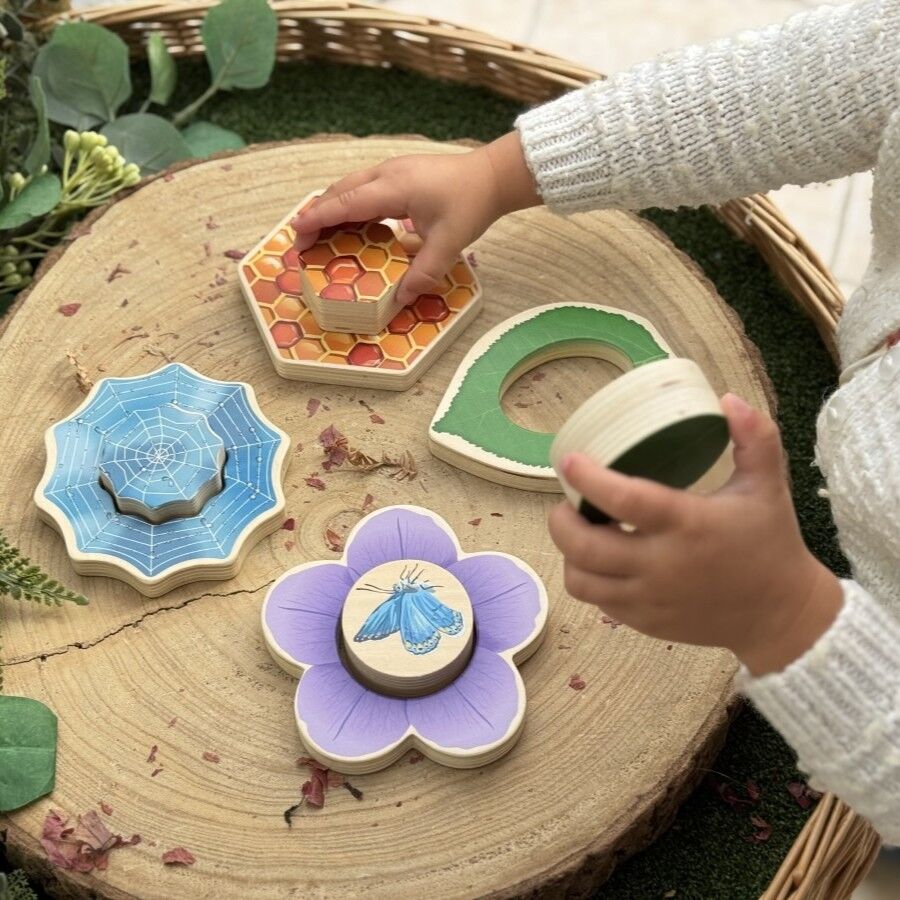


Who's Hiding? - Garden Bugs
Who's Hiding? - Garden Bugs
SKU:BB113434
Couldn't load pickup availability
This set of beautifully illustrated, double-sided FSC-certified wooden puzzles offers an engaging and playful way to introduce young children to garden biodiversity and natural habitats within an Australian ELC setting.
Each set includes four two-piece puzzles featuring a chunky, raised insect piece that fits snugly into a matching base, ensuring a satisfying and accessible experience for developing fine motor skills and hand-eye coordination.
The innovative double-sided design allows children to complete a habitat scene on one side or flip the piece to reveal the hidden creature inside, fostering curiosity and scientific enquiry.
Educators can use these puzzles to spark conversations about the environment as children place a butterfly on a flower, a bee in a honeycomb, a ladybird on a leaf, and a spider in its web.
The chunky pieces are designed to stand upright, encouraging open-ended storytelling and imaginative play beyond the puzzle board.
This resource aligns seamlessly with the EYLF by promoting a sense of wonder about the natural world while supporting cognitive development through matching, sorting, and problem-solving.
Learning Outcome Connections
Outcome 2.4: Children demonstrate an increasing knowledge of and respect for natural environments by exploring the symbiotic relationship between garden insects and their specific habitats.
Outcome 3.2: The manipulation of chunky, raised puzzle pieces allows children to take increasing responsibility for their physical wellbeing by refining fine motor strength and hand-eye coordination.
Outcome 4.1: The double-sided "hide-and-seek" design encourages children to develop dispositions for learning such as curiosity and persistence, as they investigate and uncover hidden creatures.
Outcome 4.2: Children demonstrate the ability to transfer and adapt what they have learned by using the standing puzzle pieces as characters in open-ended storytelling and imaginative play across different contexts.
Outcome 5.1: These puzzles act as a catalyst for communication, prompting children to use descriptive language to identify insects and share their discoveries with peers and educators.